
Regulations are tightening. Legacy infrastructure isn't.
The EPA’s strict new Maximum Contaminant Levels (MCLs) have fundamentally shifted the economics of water remediation. Environmental engineers and municipal water operators are under unprecedented pressure to capture pervasive, highly mobile PFAS compounds—yet the industry is forced to rely on legacy materials designed decades ago.
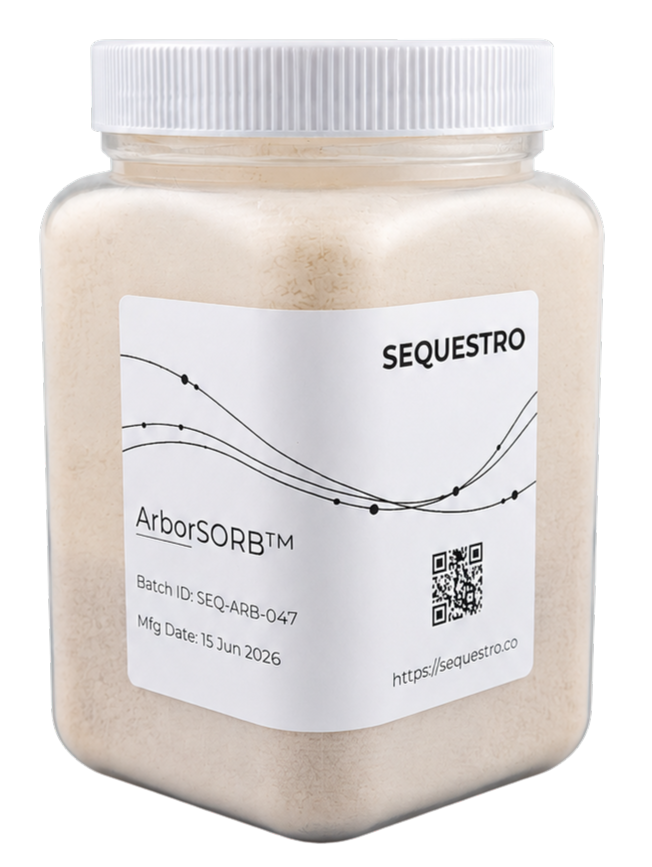
Introducing ArborSORB™ – performance without compromise.
Born from years of advanced material science research at the University of Michigan, ArborSORB™ is a proprietary, high-affinity adsorbent using German process engineering to bridge the gap between PFAS capture efficiency and operational economy.
| Feature | Activated Carbon (Granular AC) | Ion-Exchange Resin (IX) | Sequestro |
|---|---|---|---|
| PERFORMANCE | Struggles with short-chain PFAS; requires long contact times; fouls easily. | High efficiency for most chains, but at a high cost. | Resin-level removal of both short and long-chain PFAS. |
| Kinetics | Slow (>10 min EBCT). Requires massive, expensive tanks and buildings to house them. | Fast (~3 min EBCT). Smaller footprint but high media cost. | Ultrafast. Minimal footprint; maximum throughput. |
| O&M Intensity | High. Frequent change-outs due to low loading capacity and fouling. | Better performance, but often requires pre-treatment infrastructure. | Low. High capacity means longer run-times and fewer change-outs. Low co-contaminant sensitivity. |
| Sustainability | Coal or Coconut husk (Variable quality). | Synthetic Polymers. Introduces microplastic liability. | Bio-Renewable Wood Residuals.
A clean, reliable, and sustainable scaffold. |
| Total Cost | Moderate. Low CAPEX, but high recurring OPEX. | High. Significant initial CAPEX and specialized infrastructure. | Low. AC-competitive pricing with Resin-level performance. |
Break the trade-off.
Meet ArborSORB™.
Born out of breakthrough chemical engineering labs at the University of Michigan, ArborSORB™ is a proprietary, bio-renewable adsorbent platform that eliminates the compromise between financial viability and absolute remediation performance. We deliver Ion-Exchange level affinity and ultrafast capture kinetics at a Granular Activated Carbon commercial footprint.
How ArborSORB™ Works.
ArborSORB™ isn't just a new material; it’s a proprietary materials platform. We use a simple manufacturing process to transform renewable lignocellulosic scaffolds into high-affinity adsorbents. The result is a media that doesn't just filter water—it actively attracts and locks away PFAS molecules.
The Lignocellulosic Scaffold
Unlike synthetic resins that rely on expensive petroleum-based polymers, our process utilizes the natural, intricate structural features of wood. This provides a massive surface area for PFAS capture at a fraction of the raw material cost.
High-Affinity Surface Engineering
Through our proprietary modification process, we decorate the wood surfaces with active sites, specifically designed to attract and bond with PFAS—pulling them out of the water stream instantly and permanently.
Ultrafast Adsorption Kinetics
Because of the naturally beneficial wood architecture, combined with the high density of active sites, the "Empty Bed Contact Time" (EBCT) is reduced significantly—allowing for higher flow rates through smaller vessels, drastically reducing a treatment site’s physical footprint.
Ultrafast Adsorption Kinetics
As a wood-based material, ArborSORB™ integrates seamlessly with existing disposal pathways, most notably landfilling and incineration, and emerging destruction technologies alike, including pyrolysis and microbial digestion.
ArborSORB™ Technical Specifications & Performance Advantages
ArborSORB™ is engineered to provide a high-precision alternative to legacy adsorbents. By optimizing particle size distribution and surface chemistry of our lignocellulosic scaffold, we deliver consistent compliance in high-flow, high-stakes remediation scenarios.
Kinetic Performance & Footprint
- Empty Bed Contact Time (EBCT): <IX, <<AC.
- Significantly shorter contact time. This allows for significantly higher flow rates through smaller vessels, drastically reducing the physical footprint and land requirements of the treatment site.
Adsorption Affinity & Capacity
- Target Contaminants: Comprehensive capture of long-chain (PFOA, PFOS) and short-chain (PFBS, PFBA) PFAS.
- Engineering Impact: Our functionalized surface creates powerful electrostatic bonds that delay "breakthrough" compared to carbon. High loading capacity means longer run-times between media change-outs, directly lowering your recurring O&M labor and logistics costs.
Operational Compatibility
- Form Factor: Powdered or granular drop-in media.
- Engineering Impact: Designed for seamless integration into existing infrastructure. ArborSORB™ is compatible with standard pressure vessels and gravity-fed systems currently utilizing AC or IX. Upgrade your performance without the capital expense of a total system redesign.
Material Integrity & Quality Control
- Scaffold Source: Surface-modified, bio-renewable wood residuals.
- Engineering Impact: Unlike coal-based carbons that vary by batch or mineral source, ArborSORB™ offers a consistent, engineered material architecture. The material is inherently free from heavy metals and mineral impurities often found in legacy adsorbents.
Direct, data-validated answers for remediation engineers, municipal operators, and compliance officers.
How does ArborSORB™ perform against short-chain versus long-chain PFAS compounds?
How does competitive adsorption from Natural Organic Matter (NOM) affect media life?
What is the disposal or destruction roadmap for spent ArborSORB™ media?
What is Sequestro’s current Technology Readiness Level (TRL), and can we run column tests?
For environmental engineers
Validate the kinetics in your own lab. Request a validation sample to evaluate ArborSORB™ against your specific target water matrix.
For venture capitalists
Partner on the frontier of clean-tech scaling. Review our technical briefing, pilot roadmap, and current fundraising documentation.